
Tag: Inner West Page 1 of 2

A Fair Compromise for the Eastern Suburbs Bus Network

Back in May I wrote an analysis of TfNSW’s plan to completely makeover the Eastern Suburbs bus network. With the L2 and L3 light rail lines in full operation for over 12 months, it is well and truly overdue.

Prior to the launch of L2 in December 2019, the last big piece of public transport infrastructure to open was the Hills Metro line in May of that year. The accompanying bus network redesign was fairly underwhelming and so I wasn’t expecting much from TfNSW this time around.

I was pleasantly surprised!

The plan focused on doing more with what they had, with no announcement of any significant increase in rolling stock or labour hours. Instead, they seem to be rejigging allocations to operate more efficiently.

The existing bus network (until December 5th) is based on the original tramlines that criss-crossed the Eastern Suburbs and much of Sydney until mid-century. From there, it’s been added to over the years to become the sprawling mess that it is today.

Does this map of the Eastern Suburbs' original tramways look familiar at all? Source: https://commons.wikimedia.org/wiki/File:Eastern_trams.png#/media/File:Eastern_trams.png
Does this map of the Eastern Suburbs’ original tramways look familiar at all? Source: wikimedia.

That original tram network was designed to get people (men) from their homes in the suburbs to their workplaces in the Central Business District. The transport-speak for this design is called a ‘radial network’. It’s great if you want to go in and out, not so great if you want to go in-between or round-about.

The new network (from December 5th) has been designed to foster the so-called ‘network effect’ of a large public transport system. In practice this means a smaller number of more frequent and more reliable routes connect with each other at key destinations like universities, shopping centres and train stations. This system links passengers to important local hubs from where they can change service to access a wide variety of destinations.

While the old network gave almost everyone in the Eastern Suburbs a frequent and reliable one seat ride to Central Station or Circular Quay, the new network opens new pathways connecting places that were not readily accessible by public transport.

A screenshot of a bus network map from December 2021, showing the area around Green Square and Redfern
The high-frequency network map around Green Square.

Take note of high frequency (10 minutes or better) services heading towards busy train stations that weren’t really an important part of the old network like Green Square, Redfern and (soon to be) Waterloo.

Every line on that map represents a bus, tram or train service that runs at least every 10 minutes all day. If we’d had a look at that same area just a couple of years ago the only lines present would have been the train lines. An aggregation of routes along Anzac Parade and Crown Street might have combined to provide a frequent service in some places, but there was no clarity or consistency.

This new network design allows anyone to quickly determine where and how they can readily access public transport.

The Changes

By and large, the network that will commence operation next month reflects the changes proposed back in May, but despite the recent turmoil the state government has been embroiled in, they have managed to make a few revisions.

Restoring the 373

The most significant alteration between the May and November announcements is the return of the 373. The Coogee to City bus was axed completely in the May redesign, leaving residents of the bourgeois beachside bubble forced to interchange in unsavoury Randwick outside of peak hours. Of course the reverse was also true, leaving Sydney’s troves of backpackers unable to get to the beach quite so seamlessly.

A Mark 5 Mercedes bus running as route 373 bound for Coogee Beach
An Eastern Suburbs icon.

Some residents groups, and local Labor MP Majorie O’Neill, have been particularly outspoken in the battle to save the one seat ride. Their campaign focuses on the number of bus routes being axed, rather than the number of services in operation. This seems like a miss to me, since the performance of a bus network surely shouldn’t be measured in the sheer number of bus routes it has. I suppose the simple narrative of a Coalition government axing bus routes is straightforward and easy to understand.

Thankfully, the backlash was responded to in a fairly sensible manner of compromise, returning the 373 as a high frequency service (every 10 minutes all day, every day) while generally sticking to the planned network design. Aside from restoring direct beach access from the CBD, this has the added benefit of resolving the shortage of buses operating along Flinders Street to Taylor Square, a problem I pointed out in May.

In that original iteration of the changes, only the 396 would have run from the South East to Taylor Square every 10 to 20 minutes. This represented a huge cut in service. With the 373 restored and the 396 also increased to high frequency, there will be a bus every 5 minutes down Oxford Street to Anzac Parade.

I also can’t really imagine a 370 every 10 minutes being anywhere near enough to meet beach travel demand on weekends in Summer. I think a high-frequency 373 is a good idea until the L2 is extended to Coogee Beach via the Havelock Street tram right-of-way as it should have been originally.

Of course this is a zero sum game and all those 373s are going to have to come from somewhere. A few cuts that jumped out at me were the removal of the 305 outside of peak hours, limiting access to the Alexandria industrial area and cutting the 350 at Domestic, meaning a change to the 420 to get to International.

Extending the 370 to Glebe Point

In May I pointed out that the 370 is the thorn in the side of good public transport in the Inner South. The addition of the 373 will reduce the pressure on the 370 at the Coogee Beach end and its extension down Glebe Point Road is a boon for hipsters neighbourhood hoping the Inner West. It’s also good news for Darlington, which was never a good choice for a bus layover.

I think TfNSW could’ve gone a lot further here. The Western half of what was the 370, between Leichardt and Glebe, now just ends on Glebe Point Road. It’s hard to see what value this bus route brings, when most of its route is duplicated by the very frequent 470 that runs to Broadway and Central as well.

The high-frequency network fades out fast once you get to Newtown and the more familiar tangle of bus routes resumes. It’s hard not to read this totally bizarre terminus for the ‘469’ (as it has been dubbed) as temporary.

I could see the 469 being extended East down Bridge Road through Pyrmont/Ultimo to the CBD and perhaps down William Street to terminate at Edgecliff, or even operating as the 373 to Coogee as another cross-town alternative. With the 370 running a high frequency connection to Broadway, the L1 and 433 connecting to Central and the improved 469 running over the Western Distributor to Town Hall, the slow and inefficient 431 would no longer be needed, freeing up lots of buses to be deployed elsewhere.

This whole part of the network redesign feels like a bit of a band-aid until the Inner West region is given the frequent-network treatment that is no doubt underway.

The 307: The Campbell Street Connection

A Map of the May 2021 plan to have the 307 connecting Mascot to Marrickville
Now you seem me…

In May I suggested that the 307 from Mascot to Marrickville Metro would quickly be canned/altered. TfNSW has opted for the latter. It’s a shame, because East/West connections have always been a weak point and this plan doesn’t go anywhere near far enough to improve them. There is potential here, but a dinky low frequency bus that kind of skirts the Inner West to terminate at Marrickville Metro wasn’t really ever going to take off.

A map of the November 2021 plan with the 307 no longer included.
…now you don’t!

Looking towards the next round of network improvements, I’d love to see a high frequency route connecting Sydenham-Mascot-Kingsford-UNSW along the Gardeners Road corridor and another running the length of Cleveland Street from Newtown to Moore Park.

One way to achieve this would be by moving the 370 to Erskineville Road as I suggested in May, combining the 352/355 to run Enmore Road-King Street-Cleveland Street-Cook Road-Oxford Street and diverting the 308 to serve Waterloo. As for the Gardeners Road corridor, there’s nothing wrong with the 358 except its frequency.

Swapping the 303 and 306

This change isn’t of much relevance outside of Mascot, but the 303 and 306 have switched over their routes around Eastlakes. This is good news for UNSW students living in the Brighton area who can get to uni without going down every back street in Eastlakes. I still think the 303 is a massively missed opportunity for a more frequent, more direct connection between Rockdale-Brighton-Mascot-UNSW.

Too many ways through Surry Hills

The last questionable choice I want to rehash is the decision to run the 339 and 374 down different corridors through Surry Hills. The 2 buses serve different parts of the Eastern Suburbs, but a lot of people in Randwick, Coogee or Clovelly live close to either route, so there’s some value having them call at the same stops around Surry Hills. Living near two 20-minute bus routes becomes much appealing if you can board them from the same stop.

With the 373 now running down Flinders, I just don’t see the need to have the 339 serving Albion/Foveaux. Better to move it to Cleveland Street and maintain a decent service through there.

There would still be at least 8 buses per hour in each direction on Elizabeth, Crown and Flinders Streets, so no one in the Albion/Foveaux area would be wanting for buses.

Maybe next time.

Onward and Upward

There’s a bunch of other changes that are either smaller or don’t directly relate to my interests. The good news is TfNSW published a fairly comprehensive community submission report that explains what the feedback said and what they’ve done to address it.

Ultimately, I think it’s a shame that the L2 wasn’t built all the way to Coogee along the existing Havelock Street right-of-way in the first place. If that had been done, the 373 really wouldn’t be necessary and the 396 could do the job of connecting Darlinghurst with the South East. This would free up a lot of rolling stock and labour that could be used to bolster the weaker East/West connections.

That said, it is great to see the state government produce a forward looking bus network redesign.

First the Northern Beaches and now the Eastern Suburbs, in years to come Sydney just might be a pleasure to traverse by bus, if not by light rail.
Erskineville Station to be twice as accessible with new southern concourse

After years of lobbying from local residents, particularly the Friends of Erko group, it looks like Erskineville Station is finally getting a southern entrance! This is an exciting example of a transport project that punches above its weight. Station upgrades over the last decade have too often focused on accessibility upgrades for lower use suburban and regional stations (perhaps in more marginal seats?) or exorbitantly expensive car parks.

This has left highly congested stations, particularly in the Inner West, with a certain grungy 20th century aesthetic. This no doubt makes train travel more atmospheric, which is very important, but I think most commuters would agree: efficiency > vibe.

What’s so good about a second entrance anyway?

A second entrance is so valuable because it can dramatically increase the size of the walking catchment of the station. A train platform is roughly 200m long. Building a new entrance is like opening a new station for the people that live past the far end of the platform. At stations like Erskineville and Redfern a new concourse can bring the station minutes closer to 100s or even 1000s of extra residents and workers.

It’s a simple idea and not especially glamorous (hello Sydney Metro, helllllllo Westconnex), but it is a great example of the sorts of small improvements that have done more to improve public transport in Sydney in the past decade than all the megaprojects rolled together. But don’t trust me, trust the academics!

Erskineville On Exhibition

The plan for the upgrade of Erskineville is currently on exhibition and can be found here.

There is also a more minor accessibility upgrade planned for Erskineville’s sister station (familial in the sense that they’re both being annexed to the Illawarra Line by Sydney Metro), St Peters. This is on exhibition here.

According to the TfNSW website, feedback for the St Peters upgrade will close on Friday March 26th, while the Erskineville upgrade will close on Friday March 29th. Your guess is as good as mine but I suggest you get in quick!

If you need inspiration, I attach my submission for the two plans below.

One particularly insightful opinion on the upgrades

Regarding the St Peters Station Upgrade:

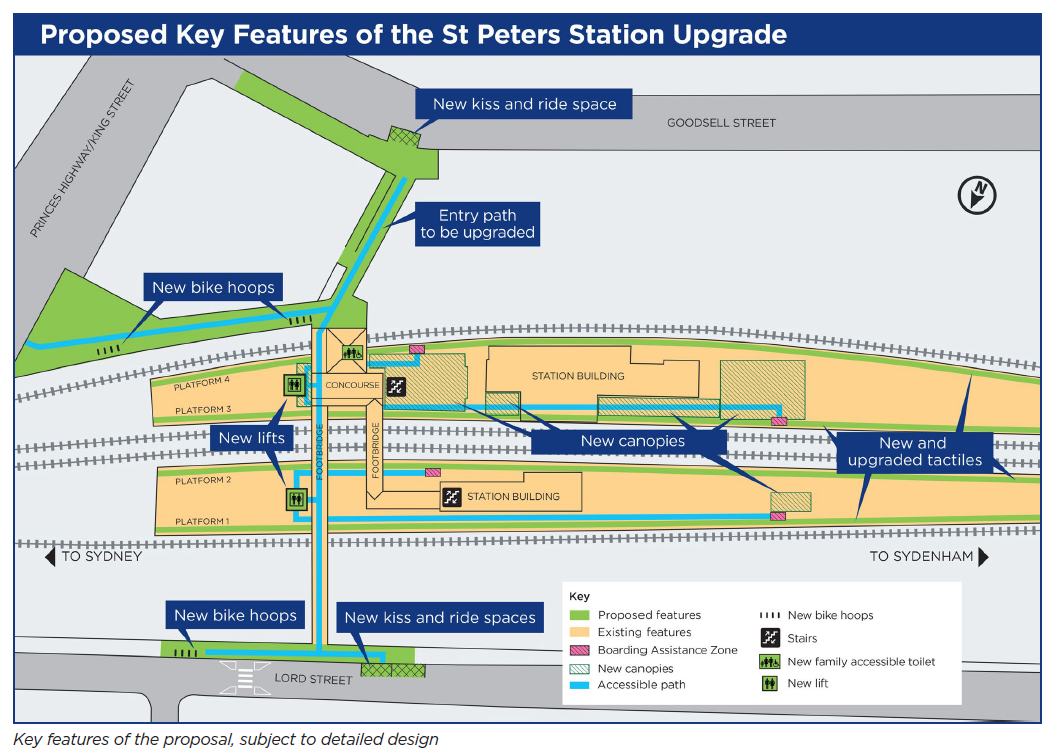
Proposed key features of the St Peters Station Upgrade map
The 2021 St Peters Station Upgrade design plan courtesy of TfNSW

I am pleased to see this busy and growing station receiving a much needed freshen up. There are a few changes I would suggest to better meet the goals of the upgrade:

1. Expand and include undercover, or even secure, bike parking. Bike hoops are one step on the bike parking hierarchy up from an incidental metal pole. St Peters station has a large catchment that is not within easy walking distance. This area has a high rate of bicycle use. Secure bike parking and an undercover bike parking area at St Peters would be an asset to the community and well used. There is room to build such a facility in the small plaza adjacent to King Street.

2. I’m curious as to why Platforms 1 and 2 have not received any significant increase in covered space compared to Platforms 3 and 4. I understand that only 2 platforms at St Peters station are regularly utilised, and I assume that the final service arrangement after the opening of Sydney Metro Southwest will make Platforms 3 and 4 the most used. However, if money can be spent providing lift service to Platforms 1 and 2 it is clear they will still be used and thus it seems shortsighted to not improve canopy cover in line with this.

3. I notice in the Environmental Factors Review the off-peak bus frequencies are not correctly listed. The 370 and 422 run at an off peak frequency of 15 minutes more often than the stated 30 minute frequency. While most users of St Peters reach the station on foot, some do use the bus interchanges and misrepresenting service frequency in this way could lead planners to neglect to facilitate these important connections. The 370 in particular is a frequent and important crosstown bus route and good connection facilities such as bus stop infrastructure, lighting and wayfinding are important at St Peters.

Regarding the Erskineville Station Upgrade:

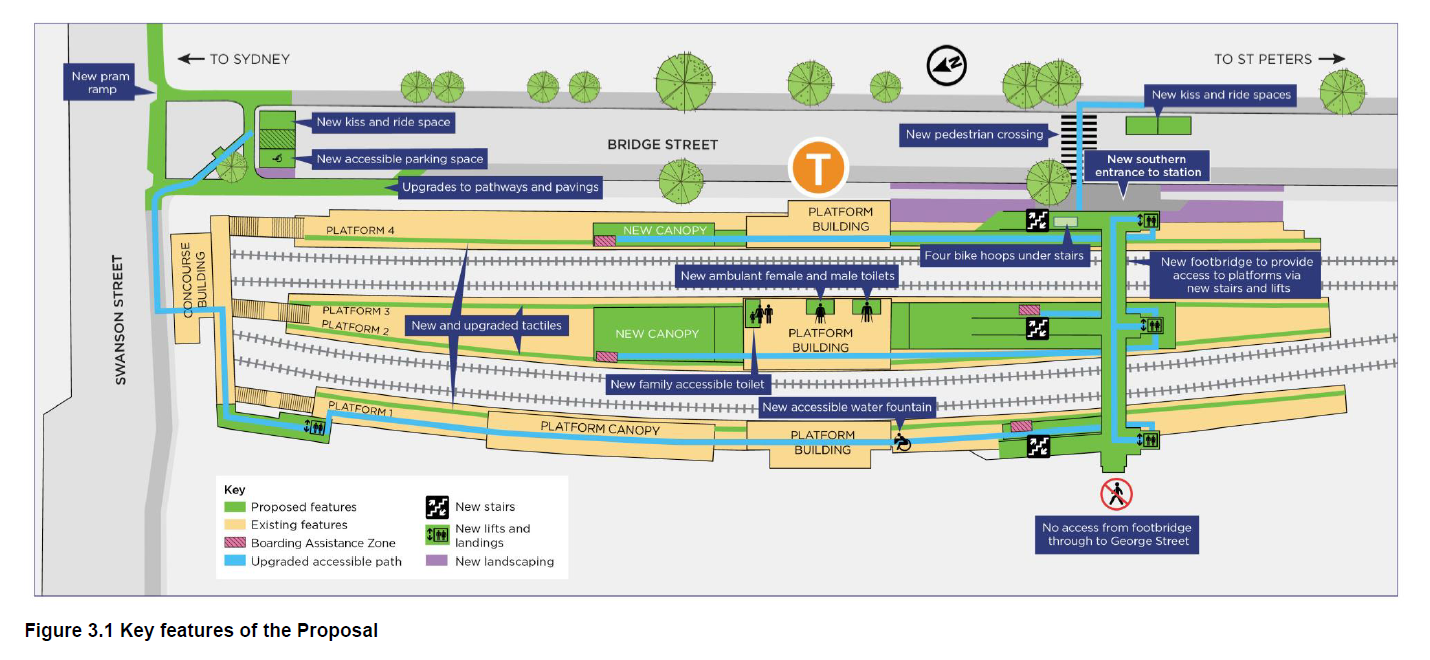
Proposed key features of the Erskineville Station Upgrade map
The 2021 Erskineville Station Upgrade design plan courtesy of TfNSW

I am especially pleased to see the hard work from WalkSydney and Friends of Erko has paid off in calling for a southern concourse at Erskineville Station. In dense neighbourhoods such as Erskineville the impact on accessibility of having only a single station entrance at one end of the platform is significant. Placing two station entrances can dramatically increase the walking catchment of a station making it more useful to more members of the communities it is intended to serve. I hope that this knowledge will inform future upgrades and new station footprints for Sydney Trains and Sydney Metro.

There are a few changes I would suggest to better meet the goals of the upgrade:

1. The obvious omission from your proposal is the lack of a connection from the Southern Concourse to George Street. Not only would this provide access for local residents to the station but also facilitate access for kids to Erskineville primary school without needing to travel along busy Swanson Street.

I do not believe that putting a small at-grade concourse entrance would result in a significant loss of green space. Instead, it would result in more people travelling through the park and facilitate greater incidental use. There would remain a large number of pocket parks and larger green spaces throughout the neighbourhood.

2. I am unsure as to why your plan has included the construction of a lift between Platform 1 and the Northern Concourse. As per my feedback at St Peters, I assume that Platform 1 is not likely to be regularly used once Metro Southwest opens. Building this lift would add significantly to the cost of the project. I assume that outside of trackwork and special events the primary function of the lift would be to facilitate access from the shopping strip on Swanson Street to the accessible Southern Concourse. I contend that this access could be provided more cheaply and effectively by upgrading the pedestrian amenity and accessibility of Bridge Street. This would mean that passengers requiring accessible entrance could travel down Bridge Street and up the lift at the Southern concourse, rather than needing to go down the lift onto Platform 1 and back up the lift to the Southern Concourse. This would mean one less lift movement for less mobile passengers. If there is a different reason for the installation of the lift at the northern end of Platform 1, it is not made clear in the proposal. I would then be curious as to why lifts are not being installed at the Northern end of Platforms 2,3 and 4.

3.The placement of the vehicle drop off zone at the dead end of Bridge Street will mean a lot of unnecessary vehicle kilometres travelled along Bridge St, contributing to congestion. A driver dropping a passenger on their way elsewhere will need to travel into and then leave Bridge Street after using the drop off zone. Drop off zones work much more effectively when placed on through routes. I would urge you to consider placing drop off zones on Swanson Street near the intersection of Henderson Street instead. There are ample car parking spaces on both sides of the road that could be changed to no-parking drop off zones. The dead end of Bridge Street could be retained as accessible only parking.

Once again, thankyou for working on these important projects and I hope that listening to the voices of the community through this consultation process will result in even better outcomes.

Submission to the Transport for NSW Haberfield, Ashfield and Leichhardt Local Network Improvements project

I put on my angry (former) local resident hat for this one. The scope of the project can be viewed here for the next 10 days and feedback can be sent to ni@rms.nsw.gov.au.

I came across this road widening project as it affects the immediate vicinity of my proposed metro station Leichhardt North. It’s frustrating to see the state government going in, what I see as, the completely wrong direction. Turning inner city communities over to wider highways and faster roads. Cities around the world are going in a different direction and the Covid-19 pandemic could be our chance to do things better. Unfortunately, this project is probably just about ‘shovel ready’ and so, in a horrible twist of so-Sydney irony, the pandemic might actually justify worse pedestrian amenity.

I encourage anyone affected by this project to make a submission. Here’s mine for inspiration:

I’d like to make a submission regarding the Transport for NSW ‘Haberfield, Ashfield and Leichhardt Local Network Improvements’ project. My objection to this project is that it is focused solely on the movement of vehicles and takes no consideration of pedestrians, cyclists, public transport users or urban amenity.


Part of the justification for the Westconnex project was to reduce the volume of surface traffic and allow surface roads to act as neighbourhood assets rather than high volume, high speed traffic corridors. Given this, why is the City West Link being upgraded to handle ever greater volumes of traffic at the expense of local amenity and less harmful modes of transport? And why does this roughly coincide with the opening of the Westconnex M4 East and Rozelle Interchange projects? Wouldn’t this be the time to look at projects to return surface roads to meet community needs?


The benefits of supporting non-automobile based modes of transport are well documented, but I will touch on them briefly. Active and public transport create healthier and happier communities by reducing the impacts of pollution, encouraging incidental exercise and helping people reconnect with place in their neighbourhoods. Absolutely, through transport is essential in a large city, but a 6 lane toll road that duplicates the City West Link is partially complete already.


The planned developments of this project are particularly problematic because of the nature of accessibility in the area. The Inner West is dense mixed use area and the Bay Run is an extremely popular site of recreation.


The Mortley Ave/Timbrell Drive redesign still fails to feature pedestrian crossings on all 4 roads. Instead, to get from the extremely popular walking and biking route on the Bay Run to Haberfield, one would need to cross the intersection 2-3 times instead of just 1. Yes, the northern side of City West Link is the busiest road in that intersection, however a pedestrian crossing there could be timed with the Timbrell-Mortley movement, with a red left hand turn for the Timbrell traffic if pedestrians are present.


Placing the fast movement of vehicles ahead of all else at this intersection discourages people from enjoying the Bay Run, annexes the recreational spaces from the adjacent residential areas and will lead to frustration for pedestrians and cyclists, dramatically increasing the risk of injury or death to our most vulnerable road users.


This is exactly the kind redesign that goes against the spirit of what Westconnex was supposed to achieve for affected communities. Our harbourside surface roads should be made usable for pedestrians and cyclists as well as cars and trucks.


The planned rebuild of the Norton and James Streets intersection is even more disappointing. The total lack of regard for pedestrians is obvious, as the mapping tool on your consultation portal (https://v2.communityanalytics.com.au/tfnsw/iwlocal/map) showing traffic movements through the new mega-intersection doesn’t even feature pedestrian movements.What is most galling about this is that this isn’t a large remote highway interchange, but is immediately adjacent to a light rail station and several important bus corridors in a walkable neighbourhood.


According to the indicative map a pedestrian trying to simply get from the light rail station to the area around Amato’s bottle shop will need to cross 4 sets of lights, rather than the current 2. Do you honestly expect pedestrians to wait patiently, day in, day out for all these lights to change? People will cross against the lights in frustration at being totally designed out of their neigbourhood and, eventually, someone will be killed.

Waiting on barren concrete traffic islands by large highways is extremely unpleasant and can even feel unsafe at night. This redesign deliberately makes the pedestrian environment much less pleasant and safe and will directly result in less people walking, cycling and using public transport in the immediate area. Thus inducing people to use private vehicles and justifying the sorts of decisions that lead to projects like this in the first place.


This intersection redesign will likely ease congestion on City West Link and in the immediate vicinity, however it will induce extra traffic onto all of the affected roads. None of these roads can handle this. Darling Street in Rozelle is extremely congested, particularly on weekends. Norton Street is a low speed shopping street and bus corridor, not a through road for private vehicles. Darley Street leads to congestion hot spots at Parramatta Road and in Lewisham.


I am not a traffic engineer, however it strikes me that reducing the variety of movements through the intersection could relieve traffic somewhat. Norton Street is an asset to the community and a greater focus should be placed on turning this into a bus, cycling and pedestrian route, as well as maintaining local vehicle access.


Perhaps removing the right turn option from City West Link heading south could free up space in the intersection? Cars and trucks could still use Ramsey Street or turn left onto James and then loop onto Balmain Road. Similarly there is a right turn off City West Link heading north, why does this need to be available? There is already a right hand turn at Balmain Road.

It seems to me the most important movements through the intersection are people continuing on City West Link, traffic heading from Darley citybound on City West Link and vice versa, traffic movements from Darley north to James and vice versa, buses on Norton St and pedestrians coming to and from the light rail station. Let’s think creatively about how we can facilitate all these important movements without marginalising people from the space entirely and further ripping this suburb in two.


We cannot build our way out of traffic congestion in the inner west. The last 50 years of road building is a testament to that. How many communities recreational and other transportation needs must be sacrificed in this pursuit?

I hope that the RMS is able to see beyond a blind desire to increase vehicle movements through this intersection to understand the impacts that successive projects of this nature have on the health, accessibility and livelihoods of the affected communities. Please go back to the drawing board on this project and figure out how Westconnex can be used as an opportunity to return surface roads to the neighbourhoods within which they exist.

Page 1 of 2

Powered by WordPress & Theme by Anders Norén