In the lead up to next month’s state election Chris Minns and NSW Labor have been dropping transport policy ideas like they’re going out of fashion.
Much of it seems to be ill-thought-out populist dogma that is, at best, harmless: mobile phone chargers at busy train stations, or manufacturing more trains locally. The first is a cute irrelevance, while the second could be a boon for Newcastle but is really an employment and business policy, rather than a transport one.
Last week’s high-profile policy unveiling is anything but harmless.
If elected, NSW Labor has promised to introduce a $60 weekly cap per vehicle on toll roads in Sydney thus ending ‘Toll Mania’. Their argument is simple and easy to pitch in the short-attention-span world of social media: public transport fares are capped, so tolls should be too.
The logic is flawed and if this policy is introduced it will be bad news for the state. Let’s have a look at why.
Public transport is a social good, cars are not. We, collectively, want people to take public transport. Cars, usually carrying just one person, produce a negative externality to the city. They cause congestion, they pollute, they need to be parked somewhere all day and night and, once in awhile, they crash into a pedestrian or cyclist and kill them. We subsidise public transport because we can all get around faster, more healthily and safer when people use it. Just because we cap Opal fares does not mean we should cap tolls.
Induced demand. Cheaper tolls will encourage people to drive more. If you’re planning a trip for Saturday and you’ve reached your Opal cap, you know that you can take the train for free. Hooray! If Chris Minns’ policy becomes reality this logic will apply to toll roads. You could do laps on the M5/M7/M2/Eastern Distributor all weekend if you fancy. For free. Free for you, anyway.
There is no such thing as a free lunch when it comes to tolls. The NSW government collects all public transport fares in the state and uses them to (partially) pay for all public transport service. This applies even if the bus or train is run by a private operator. Tolls do not work like this. One company, Transurban, owns almost all the toll roads in NSW. Contracts have been signed stipulating toll prices. If the NSW government changes the pricing structure, they will have to pay the shortfall to Transurban. If a driver hits the $60 weekly cap the rest of their ‘free trips’ will be paid for directly by the taxpayers of NSW.
NSW stands for New South Wales, not Newcastle-Sydney-Wollongong. Minns’ is keen to point out that that the brunt of road tolls are worn by residents of Western Sydney. This is undoubtedly true. After all, our toll roads are in Sydney and the people that use them generally come from areas that lack high quality public transport or walkable mixed-use neighbourhoods. If this policy is enacted, residents from regional NSW, public transport users and anyone that does not regularly take toll roads will be directly subsidizing the road use of those that do. It’s a transfer from rural to urban, from public transport to motorists, from have-nots to haves.
This policy is regressive. It is targeted firmly at the middle. Labor have stated just 51,000 car owners will benefit from the policy. The rich don’t care about tolls, although they will benefit too. The poor are less likely to own a car and less likely to take toll roads often. This policy doesn’t reduce tolls in a way that benefits occasional users such as people from the country, public transport users and those that work locally. It will only benefit regular toll users that are clocking in more than $60 a week.
Chris Minns is promising to end Toll Mania in Sydney by giving our state’s heaviest 50,000 users a free ride on the roads courtesy of the rest of the state. Photo credit: The St George Leader
A lot of people, I’m thinking about taxi and rideshare drivers, tradies and long-distance commuters, spend a lot more than $60 a week on tolls. These users will have their toll bill reduced dramatically and will take more trips on toll roads than they otherwise would. Why not? They’re free! All this extra money will go straight to Transurban shareholders, courtesy of the NSW taxpayer. This policy isn’t just populist, it is corporate welfare on a staggering scale.
The people of NSW deserve a government that can think critically about the rapidly changing world we live in and introduce infrastructure and policy to help us all survive and thrive. This policy demonstrates that NSW Labor are thinking only about residents of Sydney, do not take climate change or urban congestion seriously and are playing fast and loose with our collective wealth.
A toll cap will push more people onto motorways and off public transport. It will be expensive, diverting transport funding away from public transport projects and towards corporate profit. It is a regressive policy that demonstrates a profound ignorance of the complexity of our state’s transport system.
If you’re thinking of taking a punt on Labor to win the election next month you should put your money where your mouth is and buy a few Transurban shares, too.
Both Sides of the Political Divide
If you’ve spent any time in Sydney in the last 30 odd years it goes without saying that building new toll roads, alongside approving new fossil fuel projects ($), is about as close as we get to bipartisan policy in NSW. The M4, M2, M5, Eastern Distributor, Cross City Tunnel, Lane Cove Tunnel and the M7 all opened well before Westconnex got underway and it’s a he said/she said as to which major party is more responsible for the excess of toll roads in Sydney.
‘Toll relief’ projects go back almost as far and enjoy similar bipartisan support. The catch being that, with the exception of the Sydney Harbour Bridge and Tunnel tolls, any ‘toll relief’ scheme is a direct cash transfer to our privately owned tollway operators and the name ‘Transurban’ just keeps cropping up.
A quick search doesn’t leave much doubt as to who owns Sydney’s toll roads.
Bob Carr kicked off this habit all the way back in 1995 when he was elected on the promise of offering cashback for drivers on the M5 motorway; now part owned by the State Government and part owned by Transurban.
As toll roads spread like tentacles across Sydney a more holistic approach to toll relief was deemed necessary, one that didn’t quite so obviously porkbarrel a few swing seats in Southwestern Sydney.
In 2017 Gladys Berejiklian announced free car rego if you rack up a big enough annual toll bill. In 2019 the scheme was expanded to give discounted registration to moderate toll road users. Just last year the Perrottet government expanded the scheme even further and adopted the cashback model whereby drivers receive a portion of the tolls they pay back directly, in this case after exceeded a given threshold.
Not to be outdone by the Liberals, Minns’ is keen to make sure that the Labor party are offering the biggest boon to Transurban and incentivising car usage the most.
What’s most problematic about the latest iteration as put forward by NSW Labor is that it offers totally free toll road use beyond a threshold. Perrottet’s version only offers a partial discount on toll fees and spreads this benefit to a wider number of people, not just our state’s heaviest toll road users. The Labor version is more costly, less inclusive and less progressive.
Just one more toll road bro
What’s obvious through all of this is that the dream of ‘Build-Operate-Transfer’ was always too good to be true. We were promised massively discounted motorway construction where the brunt of the cost would be borne by the user and seamlessly managed by the private sector.
What we’ve ended up with is a classic late-stage-capitalism grift: the Government splits the construction bill with the private sector who sign lengthy operational contracts with over inflated toll rates and guaranteed quarterly increases, voters complain and so the taxpayer steps back in to foot the bill, only now instead of just paying for the construction of the thing we have to meet the terms of a contract designed to provide ongoing return to Transurban’s shareholders. One of whom, incidentally, is the now former Finance Minister. Although if you have a managed super fund, which is basically every person that has ever had a job, then you’re probably one too.
At this point the road out from the downward spiral is long and politically treacherous. It’s a safe bet that the two major parties will continue their one-upmanship when it comes to new toll roads and subsequent ‘toll relief’.
Come to think of it, whichever way you’re punting this election the safest bet is on Transurban.
In the wake of the completion of the Northern Beaches bus network revamp, which I commented on a few months ago, it looks like the Eastern Suburbs are next in line. This makes a lot of sense, since there has only been some minor tinkering with bus routes since the opening of the L2 and L3 light rail lines just over a year ago.
Similarly to the Beaches changes, the focus here seems to be on route clarity, an extensive high frequency (10 minutes or better all day) network, better crosstown connections and the inevitable end of the reign of the one seat ride.
The Map
This announcement is pretty early days. They’ve put out a draft network to community consultation with a planned commencement of service in late 2021. Hence there’s not a huge amount detail on frequency or operating hours.
What they have done is release a beautiful new map. And it is beautiful. At least to my not particularly aesthetically inclined eye.
Part of the new network map. Check out the whole thing here.
I love how prominent the heavy rail, light rail and ferry routes are. I love the highlighting of the frequent network to be on par with these other modes and how, beyond the inevitable complexity of a bus network map, you can quickly trace out the lines that might be useful for you. This is even more stark on the high frequency only network map that was on the promotional flyer.
A similar area showing high frequency (10 minutes all better all day) services only. Super handy for casual visitors to the area.
That said I feel like the frequent and ‘local’ bus colours could be slightly more differentiated and I’m missing something that matches the yellow B1 on the Beaches map. It’s all a bit blue once you get away from the CBD.
Check out the comparison to the existing map, though!
Clutter! Chaos! Confusion! And why isn’t the 418 shown between Kingsford and Sydenham? You can view the full map in all its glory here.
Aside from simplifying the palette, the big news is that bus routes from adjacent regions have been included on the map! This minor change is actually a huge deal as it sets the map as customer rather than operations focused. It’s showing users what is actually there rather than delineating service by subcontractor, a situation which is unfortunately still prevalent across Greater Sydney.
My particular bug bear, the segregation of the 388 and 389, will no longer be the case! On that note I should also add that the once daily trip for the 388 looks set to survive the changes.
But where’s the B3?
I feel like this network unveiling is the death knell for the B1/BX major bus route numbering system. It’s a shame, it had such promise!
The State Government’s 2013 Sydney’s Bus Future plan set out an elaborate plan for 13 ‘rapid’ ‘turn up and go’ limited stops bus routes. In one way or another, to a greater or lesser extent, quite a few of these have been implemented.
Pretty consistent incremental improvement on the L90/B1, the 333 and the L20/M52/500x have see these corridors grow to almost meet the standards set out in Sydney’s Bus Future. There’s been a lot of increase in service on some of the other 10 rapid routes, mostly through the metrobus project, but they’re still running at closer to a 15 minute frequency and there’s not much in the way of limited stops service or bus priority anywhere in Greater Sydney.
All that to say, when the B-Line was unveiled it seemed like in years to come Sydney would be crisscrossed by high frequency, traffic prioritised buses like the B1.
But then nothing happened. Even the extension to Newport was called off.
Last year when a new network was announced for the Northern Beaches featuring a high frequency limited stops bus between Chatswood and Dee Why I was sure it was going to be the B2. It just seemed sensible. Unfortunately, they went for the much less catchy 160x.
That, and then redoing the Eastern Suburbs network without renaming the 333 to the B3 is definitely a sign of things to come. It just feels weird, we’ve got the T1 through T9, The F1 through F9, now we’ve got the L1 through L3 but the B1 is all alone by itself.
There’s really no obvious difference in operating style between the 333 and the B1. They both run 24 hours, albeit slightly altered at night, they both run limited stops, high frequency and use unique rolling stock. I guess TfNSW want to keep the B-Line stops a bit special with their next service screens and yellow trimmed seats, but if the stop at Neutral Bay meets the standard it surely wouldn’t be that hard to roll them out down Oxford Street.
Manly Vale B-Line stop and specially built park and ride car park behind it. Source TfNSW
So What’s Changed across the Network
Well, a lot. Too much to go into it all here. The main drive behind the redesign is the reduction of the volume of buses running into the CBD in direct competition with the light rail. Reading between the lines on the brochure it looks like this is a cost neutral network change, so all the extra frequency we’re getting on crosstown routes is basically coming from a reduction in radial CBD services. Given that the L2/L3 are running all day 8 minute frequency and are down to 35 minutes average trip time end to end this strikes me as a great thing!
The focus of the frequency network seems to be on direct(ish) routes, connecting multi-model interchanges and key trip generators as well as enhancing existing popular corridors. The shift to working from home for the professional classes makes the idea that we should have a peak focused CBD centric bus network seem even more irrelevant than it already was. The one seat ride legends should be glad they’ve retained as many Bent Street expresses as they have, I’m sure some of them will be phased out at the next network review in 5 years time. Hopefully we’ll have Maroubra and Coogee light rail extensions by then and an announcement of the Metro West extension to Zetland and beyond which would free up even more bus capacity for local/crosstown frequent routes.
A couple of changes I do like: I’m a big fan of the 353/400 on steroids AKA the BJ to Airport via Coogee 350 which is a totally new connection that I think will be useful for lots of different people.
I also like how the 392 provides a much improved off-peak service to Bunnerong Road and then after connecting to the light rail deviates to (the yet to open) Waterloo Metro and Redfern Station. The detractors will focus on the loss of a direct CBD bus route, but I think the ease with which you can reach a much wider variety of destinations from Matraville is a huge improvement. Plus, you’ve still got your peak hour one seat ride to Bent Street, so all is well.
The other thing that caught my eye is the opening up of the street network around Zetland and the buses being rerouted to benefit. The 304 and 392 cut a much smoother line through the area than their predecessors.
Buses After Dark
I spent far too much of my youth shuttling around the Eastern Suburbs at night and if you weren’t heading outbound, on a Friday or Saturday on a key bus route like the 380 or the 373 you were basically stuffed. It took a lot of hustle and not very much money to stand at a cold, dark bus stop waiting for a once hourly bus in the pre-tracking days, and that was on the few routes that had service. I remember wanting to get to BJ from Randwick at, like, 9:30pm and being like, oh, I guess we’ll just have to walk.
To be fair, things have changed a fair bit in the intervening years but this plan represents a huge departure from those days. The published map includes a nightbus route network which shows where you can pick up a bus at any time of day or night and it’s quite extensive. Unfortunately it’s still mostly set to hourly frequency on weekdays and half hourly on weekends. But, it’s great to see Sydney leaving behind the idea that an absolute skeletor of a public transport network is just fine after midnight.
Some Very Specific Weakpoints (IMHO)
Here I’m going to delve into some of the elements of the plan that I don’t think quite work. If you aren’t as excited about bus routing as I am, it might get a bit tedious and I’ll forgive you skimming through.
Inconsistent CBD-bound routing
I don’t quite understand why the 3 remaining Citybound Anzac Parade/Alison Rd buses are all taking different routes into the CBD. It seems like the planners have just left these routes as they were, only all the other routes have disappeared leaving them sad and alone.
During the day the 374 and 339 will run every 20 minutes and the 396 will run every 10. In the evening they’ll run at about half that frequency. After passing Moore Park the 339 will take Foveaux/Albion, the 374 will run down Cleveland Street and the 396 will take Flinders Street. This kind of makes sense from a coverage point of view, but in context, these streets are all surrounded by important transport corridors. It doesn’t seem likely that many people will stand on Cleveland St waiting fifteen minutes for a bus when they could take a high frequency 304 from Crown, 343 from Chalmers/Elizabeth or the light rail from Surry Hills.
In peak hour there’ll be a bunch of express buses on Albion/Foveaux, but the rest of the day it’ll just be the 339 trundling past occasionally.
It would make sense to run the 339/374 along the same corridor as they share a lot of common catchment in Randwick/Coogee/Clovelly. Combined, they could run down Cleveland OR Albion/Foveaux at a much more respectable 10-minute frequency. Cleveland Street is probably the more logical choice for coverage reasons, I don’t really see anyone catching the 339 to get from Surry Hills to anywhere bar Clovelly. I can see plenty of upside to this plan but I can’t think who would lose out. It just doesn’t seem necessary to run moderate frequency local buses along both corridors.
Then there’s the 396 which, out of peak, will be the only Anzac Pde bus running down Flinders Street. That means there’ll only be a bus every 10 minutes turning right out of Oxford onto Flinders, down from every 5 or so minutes today.
It’s a popular transport corridor so hopefully this level of service will cut it. I’m more concerned about evenings when I suspect lots of people will be trying to get from Darlinghurst back home with their only option being the 396 running every 20 to 30 minutes.
Unfortunately there’s not even an obvious interchange to make. I suppose if you’re heading to Coogee you could go via Bondi Junction and then take the 350. I’m not sure this is time competitive. Alternatively, you could walk half a dozen blocks to the Surry Hills light rail stop, but if you’re coming from the Cross, St Vincents or anywhere in Darlinghurst really, just getting to Taylor Square is probably enough of a walk.
I’m not really sure what the fix is here without running more buses alongside the light rail. Given that the light rail provides plenty of access to Central, another option would be to route the 339/374/396 all via Flinders Street for a 5 minute day time frequency and every 10 to 15 minutes in the evening.
The oft overlooked Grand Parade connection
The 303 extension down the Grand Parade is pretty useless at the best of times. It only runs hourly, doesn’t run at night and doesn’t really serve any especially useful interchange points before it reaches UNSW. I am probably one of the few people that has ever used it to get from South of the Cooks River to the Zetland area, so cutting it at UNSW makes sense.
My concern is that the 303 now covers the old 301 deviation through every other backstreet in Mascot which will mean that it’s no longer really a bus you would choose to catch. It feels like the 303 is predominately now a catchment service for the residents of Eastlakes, which begs the question, why extend it to Brighton-Le-Sands at all?
With the strong demand for the 420 and the 478 I think that promoting a decent service connecting the medium to high density neighbourhoods at Brighton and Ramsgate with the South Eastern suburbs is obvious. I reckon there’s enough latent demand to justify combining the 478, 479 and 303 into an every fifteen minute directish bus from Rockdale to UNSW via Brighton and Kingsford.
Unfortunately, the proposed new network makes this connection somehow even worse than it was.
No matter what you do, the 370 will always be a weakness
The 370. Obviously the reliability of the 370 has been a huge problem since forever and the improving frequency, while welcome, probably hasn’t helped greatly with the reliability. Cutting it at Sydney University seems like an okay way to deal with it, although you’ve now got the 370 and the 369 both laying over in Darlington which will might cause some congestion there. It seems like a missed opportunity to actually change the bus routes for the better.
The key issue here is that we’re getting the large volumes of students travelling between the UNSW and USyd areas to their destination via quite a roundabout route through St Peters.
From the heart of USyd on City Road to Erskineville Oval is a 2.2km walk, 22 minutes for a brisk trotting student. It’s much less as the crow flies, but we don’t have a pedestrian bridge over the Eveleigh railyards…yet. The 370 takes 15 minutes at the best of times to cover that distance. When you add in waiting time and the possibility for delays, it’s safe to say it’s quicker to walk for most.
I’d say that the vast majority of the passengers on the 370 heading down Mitchell Street are heading to Newtown Station, Broadway or somewhere in between. If the 370 was diverted down Erskineville Road it would shave 5 minutes off the journey, which isn’t insignificant.
Of course this isn’t a perfect fix and would definitely raise other problems, but I guess my point is that the 370 will always be a challenge for good bus network design. There is a strong need for reliable and frequent crosstown connections from the Inner West to the East but I’m not sure that leaving the 370 more or less as-is is the best approach here.
So much for Sydenham
While we’re on the topic of crosstown buses…what happened to the 418? As with the 400, the Burwood to Bondi Junction run was a bit long, but it can’t have been more than a few years ago it was cut off at Kingsford to resolve this very issue.
It looks like the 418 has now been cut off at Sydenham with the Eastern part of the route replaced with the 358 to Randwick.
With the increasing importance of Sydenham Station this doesn’t much matter as most passengers will be changing to trains or the metro. What will be important is the frequency of the 358.
The 418 is currently running every 30 minutes between Sydenham and Kingsford, but I don’t think this is adequate at all. Gardeners Road is the southern crosstown route and should be supporting a decent connection from Mascot and Sydenham Stations to UNSW and Prince of Wales. The new proposal suggests a 20 minute frequency which is an improvement, but inadequate to connect with the 10 minutes or better train services at Sydenham and Mascot.
I guess realistically people on the East Hills Line and the Bankstown Metro will probably just stay onboard until Waterloo/Green Square and change for the high frequency 370 there, or even go to Central and take the light rail. This seems a shame as it increases demand at already overcrowded CBD stations quite unnecessarily. I feel like there’s latent demand for a much better crosstown Gardeners Pde bus route which will only grow when Sydenham metrofies.
The 358 between Sydenham and UNSW is my pick for the next frequent bus route.
Connecting to the (Marrickville) Metro
The 307 extension is pretty funny to me. It’s great to see a bus service using the new Campbell Road connection over the Alexandria Canal, but I can’t help wondering who will actually use it. Marrickville Metro isn’t exactly a crash hot destination and the 307 doesn’t make any particularly useful interchanges either. It doesn’t quite go to St Peters Station, it picks up the 422 to Newtown, but you wouldn’t want to get stuck waiting on the Princes Hwy for 15 minutes for the next one.
I’m thinking it would be most useful as a way to connect the high density residential area at Mascot Station to the Inner West, but like I said, it doesn’t really go to any of the parts of the Inner West people would have cause to visit.
According to the summary of route changes most 307s will continue as route 352 from Marrickville Metro, so you can stay on board to reach Newtown. This is a bit confusing because it will likely compromise the reliability of the 352 which is now effectively running from Bondi Junction to Eastgardens via Marrickville Metro along some of Sydney’s most congested streets. It’s also strange because it’s only sometimes. I guess you have to try and pair the two timetables together and figure out if the 307 you’re getting on is one that continues as the 352 or not.
I’m putting money on this extension getting canned/altered pretty quickly.
Closing Thoughts
I think the key point here is that the frequency network is a huge improvement for accessibility, but once you get away from those core routes, you’re pretty much still stuck dealing with the same sorts of problems that have plagued Sydney bus users forever. Physical infrastructure is poor and bus priority is non-existent.
On the other hand, creating and highlighting a frequent network dramatically expands the reach of Sydney’s legible public transport system and will hopefully make more people feel like they can readily navigate to places on these routes, as they would with trains, the light rail, ferries or the B-Line.
It’s a pretty impressive frequent network given that there’s no increase in rolling stock or labour. It’s all coming from removing redundancy. Some will argue that this means forcing people onto the light rail, but if it’s running 35 minutes end to end it’s hard to see that that’s a bad thing. The residents of South East Sydney, and particularly the Labor members that represent them, might not be ready to let go of their CBD-centric peak focused network, but they’re going to be dragged kicking and screaming into the 21st century anyway. And they’ll be the better for it.
The Proposed South East Bus Changes are open for community consultation until June 18th. You can find out more information and give your feedback here.
The omnipresent election looms and Labor’s at it again. Be it state or federal, they’re tinkering at the edge of transport policy, sadly lacking in any big ideas of their own.
If the planned freeway seems half baked, it’s because it is. In reality the plan is a Liberal party attempt to get the controversial F6 started by stealth. Once the first section opens to the public they’ll be able to switch to the ‘missing link’ rhetoric so pervasive in Sydney’s transport planning and use that as a mandate to go from there.
It’s good to see the state opposition finally coming out against Sydney’s tangle of tunnels, albeit one election cycle too late. Sadly, and typically however, they lack any real vision of their own. The announcement is focused on what they won’t do, but is lacking in much detail. It all seems far too familiar to the last time we had a state labor government.
The F6 extension EIS is currently on display and open for public comment until December the 14th.
It’s not a real train station if it isn’t ringed with parking
Then on Monday, Anthony Albanese, Federal Opposition Transport Minister, announced that $16m of Labor’s $300m Park and Ride fund would be going to expanding the Leppington Station car park by 300 spaces. Some quick maths reveals that’s over $50,000 per car space to provide enough extra parking for 2 carriages worth of commuters each day. Labor’s focus on Park and Rides is typical of their compromised thinking on public transport. There’s no doubt Albo believes in the cause, but he’s also committed to the dated idea that there’s no way to get to decent public transport except to drive.
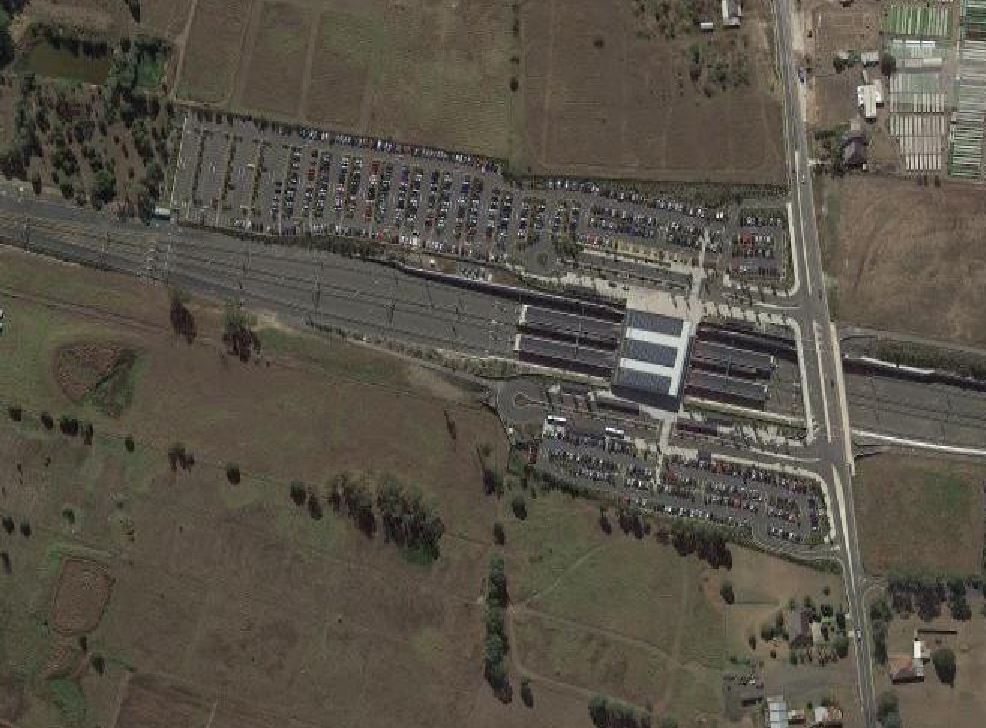
It’s unlikely you’ve visited Leppington station, but it’s pretty interesting. It’s a brand new 4 platform behemoth sitting in, what was until quite recently, paddocks.The service is good with a train every 15 minutes on the South Line and every 30 minutes on the Cumberland Line all day. That’s right, even off peak, Leppington sees 6 trains an hour. So what’s there? Well at the moment, basically nothing. The roads are being upgraded, there’s a cafe and a convenience store. No one lives within walking distance yet, although with the station already ringed by asphalt car parks I don’t see strong demand for access on foot in the future.
Asphalt as far as the eye car see. Leppington Station lacks anything much around it except parking. Source: Google maps.
The station is pretty well used. The area is in a construction boom and in the early morning it’s equally busy with tradies heading out as office workers heading in. By some accounts the 800 space car park is full by 8am, forcing commuters to try their luck on the grassy verge. On this issue, Albo had this to say:
“Many local commuters are made to walk along the side of the road back to their cars of an evening, with no footpaths and no lighting, hoping that they do not get hit by a car.”
Seems strange to me that faced with the problem of a lack of pedestrian amenity his best fix is to increase parking and induce more cars into the area. I guess local commuters will just have to continue to hope.
During the day the place quietens down a lot. I mean there’s nothing much there and with no available car parks the only way in or out would be on the bus. And the service is pretty bare bones. Four bus routes visit Leppington, two are throwaways; with a total of 11 daily departures between them (less on weekends). The other two buses head towards the housing estates to the south; the 841 to new subdivisions in Gledswood Hills and Gregory Hills (once an hour) and the 858 to Oran Park roughly every 30-40 minutes. Of course frequency is lower on weekends.
And if you plan on traveling after dark, don’t even bother thinking about using Leppington, unless you’ve driven there. Unlike the abundant late night transport in Albo’s Inner West electorate, the last bus from Leppington on a Saturday night leaves at twenty five past nine. If you’d been out to dinner in the City, you’d have to make sure to be on the platform at Central by 8:20 or you’d be enjoying a long cab ride home. Of course the trains will continue to run until 1am, but that’s only for the car owners enjoying unlimited free parking at the station. As for what the provision of over 1000 car spaces juxtaposed with a total dearth of buses after 9:30pm says about attitudes towards drink driving, well I’ll leave that to you.
It cost $1.8bn to build the Southwest Rail Link to Leppington. I can only imagine how much it costs to keep 6 trains an hour heading there. It’s great that we’re now realising that you can dodge a bullet down the track (pun intended) putting in infrastructure before housing. But failing to provide that last mile connection from the station to home means we’re really not making much use of it.